
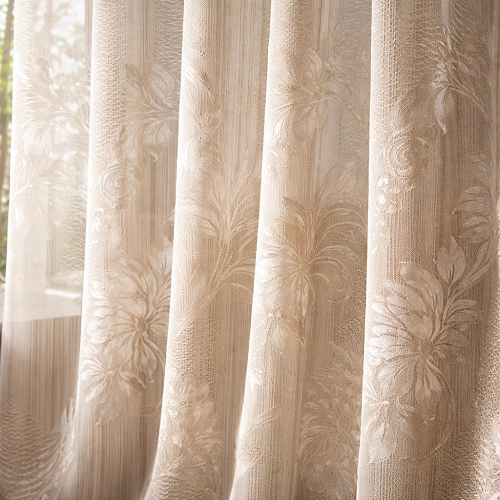
The global home textile market increasingly demands fabrics that merge sculptural aesthetics with practical performance. Among the most compelling innovations to emerge from advanced weaving and finishing technologies is the 3D Wales fabric — a burnout-process polyester material that delivers striking dimensional ribbing, rich tactile depth, and outstanding durability. Wanjie Textile's 3D Wales (Reference: B-3D0001) sits at the intersection of design and engineering, making it a leading choice for premium curtain fabric applications worldwide.
Founded in 2007, Zhejiang Wanjie Textile New Material Co., Ltd. has spent nearly two decades refining its manufacturing processes, patents, and product portfolio. This article examines the technical specifications, construction science, application scope, and competitive advantages of the 3D Wales fabric in depth — information essential for procurement managers, interior designers, and OEM buyers.
A wale in textile terminology refers to a column of loops or ribs running lengthwise in a knitted or woven structure. When expressed in three dimensions — through the burnout chemical-etching process — the wale transforms from a flat surface pattern into a raised, relief-like ridge that creates shadow, depth, and a tactile corduroy-adjacent experience without the weight penalty of traditional corduroy.
The burnout (devoré) technique selectively removes fibres from a base fabric using a chemical paste, typically an acid or alkali formulation, that dissolves one fibre type while leaving another intact. In the case of Wanjie's 3D Wales, a 100% polyester base is engineered so that the wale ridges survive the burn-out cycle, producing a high-low surface topology that is both visually dramatic and structurally coherent.
The table below summarises the standard stock specification for 3D Wales (B-3D0001). All parameters are customisable for bespoke orders.
| Parameter | Standard Value | Customisable Range |
|---|---|---|
| Product Reference | B-3D0001 | — |
| Composition | 100% Polyester | Polyester blends available |
| Weight (GSM) | 180 GSM | 150 – 260 GSM |
| Width | 150 cm | 130 – 300 cm |
| Construction | Burnout wale (devoré) | Wales density / pitch |
| Finish | Semi-transparent inter-wale / opaque ridge | Custom opacity levels |
| Colour | Multiple stock colours | Pantone-matched dyeing |
| MOQ (custom) | Negotiable | Contact for details |
Polyester remains the fibre of choice in performance curtain fabrics for several well-documented reasons. At 180 GSM, Wanjie's 3D Wales achieves an excellent balance between drape, light filtering, and dimensional stability.
| Property | Polyester (3D Wales) | Cotton | Linen | Viscose |
|---|---|---|---|---|
| UV Resistance | Excellent | Moderate | Good | Poor |
| Colour Fastness | Excellent | Good | Moderate | Moderate |
| Dimensional Stability | High | Low (shrinks) | Moderate | Low |
| Moisture Absorption | Low (ideal for humid rooms) | High | Medium | High |
| Ease of Care | Machine washable | Moderate | Difficult | Dry-clean preferred |
| Burnout Compatibility | Optimal | Limited | Not recommended | Poor |
| Cost Efficiency | High | Moderate | Lower | Lower |
Polyester's resistance to chemical degradation during the burnout etching process is its most critical advantage in this context. Natural fibres are frequently damaged beyond acceptable tolerances when exposed to burnout agents, whereas polyester's synthetic backbone remains intact wherever protected, delivering consistently crisp wale edges batch after batch.
The foundation cloth is woven or knitted to establish the wale pattern in its pre-etched form. Thread count, yarn twist, and weave interlacing are all calibrated to ensure the desired ridge height is achievable post-process.
A controlled-viscosity burnout paste is applied via screen printing or roller engraving to the inter-wale zones. Precise registration ensures clean boundaries between opaque ridges and transparent channels.
The fabric enters a curing oven where heat activates the chemical reaction. Cellulosic filler fibres in the channel zones carbonise and are subsequently removed in a washing stage, leaving the polyester wale ridges standing proud.
Residual chemicals are fully neutralised and washed out. The fabric is then tentered to correct width, heat-set for dimensional stability, and inspected against colour, weight, and dimensional tolerances before baling.
The 3D Wales fabric's unique combination of visual depth, light-filtering semi-transparency, and robust polyester construction makes it suited to a broad spectrum of uses.
| Application | Key Benefit | Recommended GSM |
|---|---|---|
| Residential living room curtains | Elegant drape, partial light diffusion | 160 – 200 GSM |
| Bedroom privacy curtains | Light control, tactile softness | 180 – 220 GSM |
| Hotel & hospitality drapery | Durability, premium aesthetics | 200 – 260 GSM |
| Office partitions & screens | Dimensional texture as design element | 160 – 180 GSM |
| Retail display backdrops | Visual impact, photogenic surface | 150 – 180 GSM |
| Stage & event draping | Dramatic light play, easy handling | 150 – 200 GSM |
One of Wanjie Textile's defining strengths is its capacity to tailor every parameter of the 3D Wales construction to the buyer's brief. Interior designers and OEM brands can specify:
Colour: Pantone-matched dyeing is available across a wide gamut. Stock colours encompass neutrals, earth tones, jewel shades, and architectural whites, enabling seamless integration into any interior palette — from modern minimalism to classic charm.
Wales Density: The pitch (number of wales per centimetre) can be adjusted from broad macro-wales for a bold, graphic statement to fine micro-wales for a subtle, textured hand-feel reminiscent of fine ribbed velvet.
Width: Standard 150 cm width covers most panel-cutting requirements. Wider looms can accommodate extra-wide treatments for statement windows and bay configurations without unsightly seams.
For buyers who supply their own base fabric or require a manufacturing partner for a proprietary specification, Wanjie's experienced team will assess feasibility and advise on process parameters. Visit the Contact page or reach out directly at info@wanjietex.com.
The Burnout Series at Wanjie encompasses several related constructions. Understanding how 3D Wales positions within the broader range helps buyers select the optimal fabric.
| Product | Reference | Surface Character | Best For |
|---|---|---|---|
| 3D Wales | B-3D0001 | Raised longitudinal ribs, semi-transparent channels | Curtains, drapery, room dividers |
| Burnout 16 Wales 3D | B-3D0016 | 16-pitch fine wales, high-density ribbing | Fashion-forward interiors, retail |
| Burnout 3D Twill | B-3D0002 | Diagonal twill relief, structured drape | Tailored panels, hospitality |
| Burnout 21 Wale | B-1905 | Ultra-fine 21-pitch wale, subtle texture | Bedroom, soft furnishings |
| Burnout T Pattern | B-2223 | Geometric T-motif, high contrast | Accent panels, statement décor |
| Burnout Grid Plus | B-2220 | Grid lattice, architectural feel | Office, commercial interiors |
Polyester burnout fabrics deliver a considerably longer service life than natural fibre equivalents when properly maintained. The 3D Wales construction is recommended for machine washing at low temperature (30 °C / 86 °F), low-speed spin, and line drying to preserve the wale relief. Ironing at low temperature on the reverse side is permissible; steam ironing directly on the raised wales is not recommended as heat may flatten the 3D structure.
From a sustainability standpoint, Wanjie Textile continues to invest in reduced-waste dyeing and finishing technologies. Polyester's durability inherently extends product lifecycle, reducing the frequency of replacement and the associated resource consumption — a consideration increasingly mandated by European and North American retail sustainability frameworks.
Zhejiang Wanjie Textile New Material Co., Ltd. has been redefining fabric innovation since 2007. The company's competitive differentiators include:
Proprietary process patents covering burnout relief construction, ensuring buyers access techniques unavailable to generic mills. These are documented on the Patents & Certificates section of the company website.
Broad product portfolio spanning the Sportwear Series, Corduroy Series, Velvet Series, Burnout Series, Spandex Series, and Mesh Series — providing a single-source solution for multi-category buyers.
Full customisation service for colour, weight, width, and construction parameters with transparent lead times communicated directly by the sales team.
Global reach with multilingual support across Arabic, French, German, Spanish, Japanese, Korean, and more than 20 additional languages — enabling seamless communication with buyers on every continent.